
The Business That Makes It Easy to Respond Usually Wins
Part 4 of The Small Business Communication Series
Every small business owner knows the feeling.
You are on a job.
You are helping a customer.
You are driving.
You are with your family.
You are trying to finish the work that is already in front of you.
Then the phone rings.
Maybe you miss the call.
Maybe someone fills out a form on your website.
Maybe they message your business page.
Maybe they ask a simple question after hours.
The problem is not always that the business does not care.
Most of the time, the business is just busy.
But from the customer’s side, it feels different.
If reaching your business feels hard, confusing, or slow, they may move on to the next option.
That is why the business that makes it easy to respond usually wins.

Customers Do Not Want to Chase a Business
Most customers are not trying to make things complicated.
They usually want something simple.
They want to ask a question.
They want to know if you can help.
They want to understand the next step.
They want to feel like someone received their message.
That is it.
But many small businesses unintentionally make customers work too hard.
A customer calls and gets voicemail.
They fill out a form and never hear back.
They send a message and wait hours or days.
They ask a question but do not know if anyone saw it.
Even if the business is good at what they do, the customer experience can start to feel frustrating before the work ever begins.
And in many cases, the customer is not comparing your skill yet.
They are comparing how easy it is to get a response.
Being Good at the Job Is Not Always Enough
A lot of great businesses lose leads for reasons that have nothing to do with quality.
They are experienced.
They do good work.
They care about their customers.
They show up and do the job right.
But the first impression happens before the job starts.
It happens when someone tries to reach you.
If a customer cannot get a clear response, they may never get far enough to see how good your business actually is.
That is the part many business owners miss.
The best business does not always win the customer.
Sometimes the easiest business to reach wins the customer.
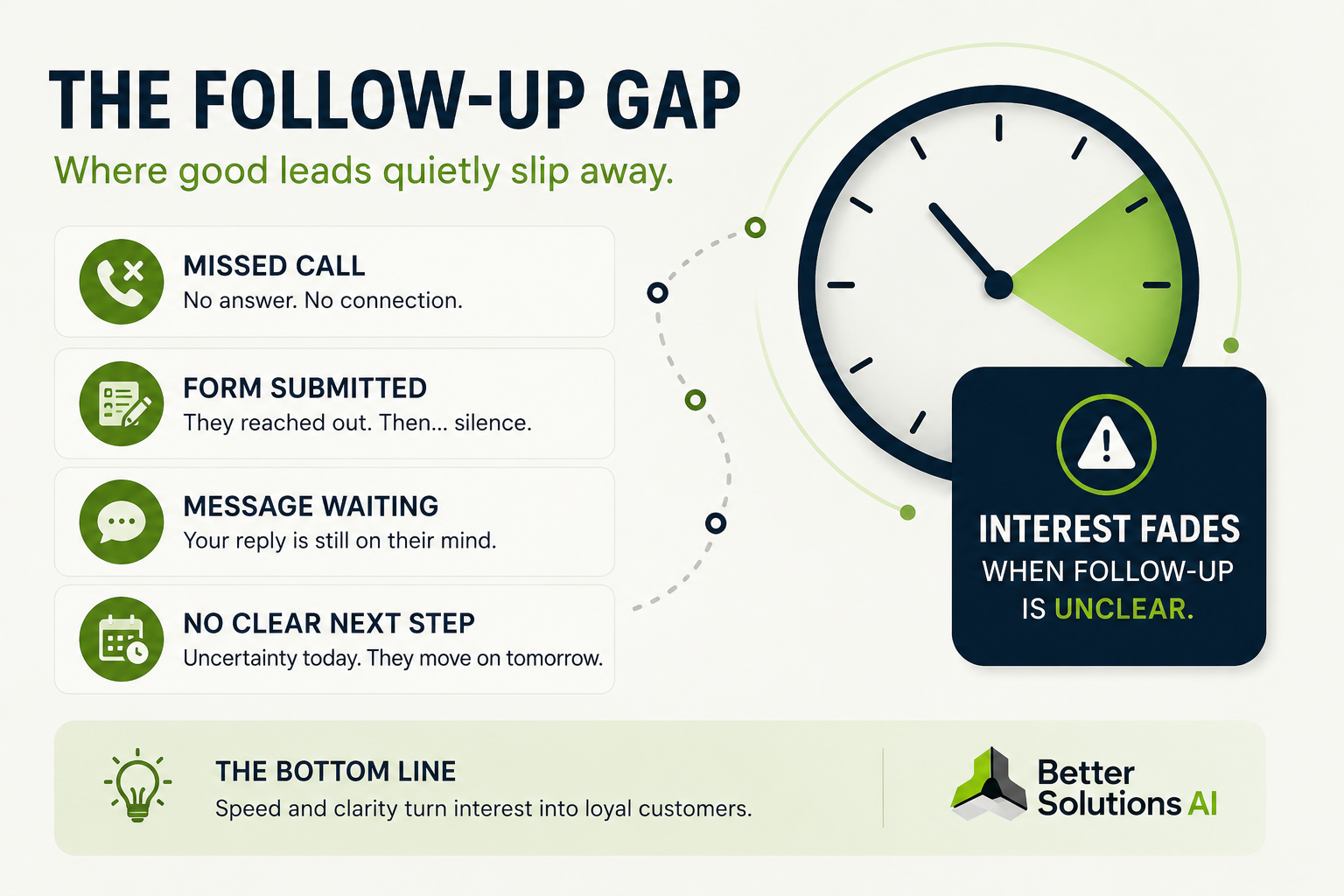
The Gap Usually Happens Between Interest and Follow-Up
Most leads do not disappear because the customer was never interested.
They disappear in the gap between interest and follow-up.
Someone visits your website.
They click around.
They fill out a form.
They call your number.
They ask about pricing, availability, service areas, or appointments.
That is a real moment of interest.
But if the next step is unclear, the lead starts getting cold.
The longer the delay, the easier it becomes for that person to keep searching.
They may not be angry.
They may not even remember your business name.
They just kept moving.
That is the danger of the follow-up gap.
It is not always loud.
It does not always show up as a complaint.
It just quietly costs the business opportunities.
Easy Communication Builds Trust
Customers do not need everything to be perfect.
They just need to feel like the business is paying attention.
A simple response can make a big difference.
“Thanks for reaching out.”
“We received your message.”
“Here is the next step.”
“We can help with that.”
“Someone will follow up shortly.”
“You can book here.”
“Here is what we need from you.”
Those small moments create confidence.
They tell the customer that the business is organized, responsive, and professional.
That matters.
Especially when the customer is dealing with something urgent, inconvenient, or important.
A homeowner with an AC issue does not want confusion.
A customer needing a repair does not want to wonder if their message went through.
A person trying to schedule service does not want to chase down answers.
Easy communication makes the customer feel taken care of before the work even starts.
The Goal Is Not to Answer Everything Yourself
This is where many small business owners get stuck.
They think better communication means they personally have to answer every call, message, form, and question the second it comes in.
That is not realistic.
Small business owners are already wearing too many hats.
They are doing the work.
Managing the schedule.
Talking to customers.
Handling estimates.
Following up.
Taking payments.
Solving problems.
Trying to grow.
The goal is not to make the owner available every second of the day.
The goal is to create a system that helps customers get acknowledged, guided, and moved to the next step.
That could be a missed call text-back.
It could be a website chat assistant.
It could be automated follow-up.
It could be appointment request forms.
It could be better lead notifications.
It could be a simple process that makes sure nothing slips through the cracks.
The point is not to replace the business owner.
The point is to support the business owner.
Small Businesses Need a Communication System
More leads are great.
But more leads without a communication system can create more missed opportunities.
If a business spends money on ads, social media, websites, flyers, SEO, or referrals, then the next question should be:
What happens when someone responds?
Do they get an answer?
Do they know the next step?
Does the business get notified?
Is there follow-up?
Is the lead captured somewhere?
Can the customer schedule or request service easily?
That is where a communication system matters.
A good communication system helps turn interest into conversations.
And conversations are what turn into appointments, estimates, jobs, and customers.

Customers Remember the Business That Made It Simple
People are busy.
They do not always want to compare ten businesses.
They do not want to leave multiple voicemails.
They do not want to wonder if a form submission disappeared.
They do not want to repeat the same information over and over.
When a business makes the process simple, it stands out.
A quick response stands out.
A clear next step stands out.
A helpful message stands out.
A business that follows up stands out.
And sometimes, that is all it takes to earn the opportunity.
Not because the customer was sold with a fancy pitch.
But because the business made it easy to move forward.
The Bottom Line
Small businesses do not lose every lead because of price.
They do not lose every lead because of competition.
Sometimes they lose leads because the customer could not get a simple response at the right time.
That is why communication matters so much.
A good website helps.
Marketing helps.
Social media helps.
Referrals help.
But once someone reaches out, the business needs a way to respond, follow up, and guide that person to the next step.
The business that makes communication easy gives itself a better chance to win.
And in today’s world, that can make all the difference.
Final Thought
You do not have to be available 24/7 to make your business feel responsive.
You just need the right systems in place so customers are not left wondering what happens next.
That is the difference between hoping a lead comes back and giving that lead a clear path forward.
And for many small businesses, that simple change can turn missed opportunities into real conversations.
Better Solutions AI
AI Automation for Modern Businesses
We help small businesses improve customer communication with tools like missed call text-back, website chat assistants, lead capture, follow-up systems, and AI receptionist solutions.
Learn more at:
bettersolutionsai.net


