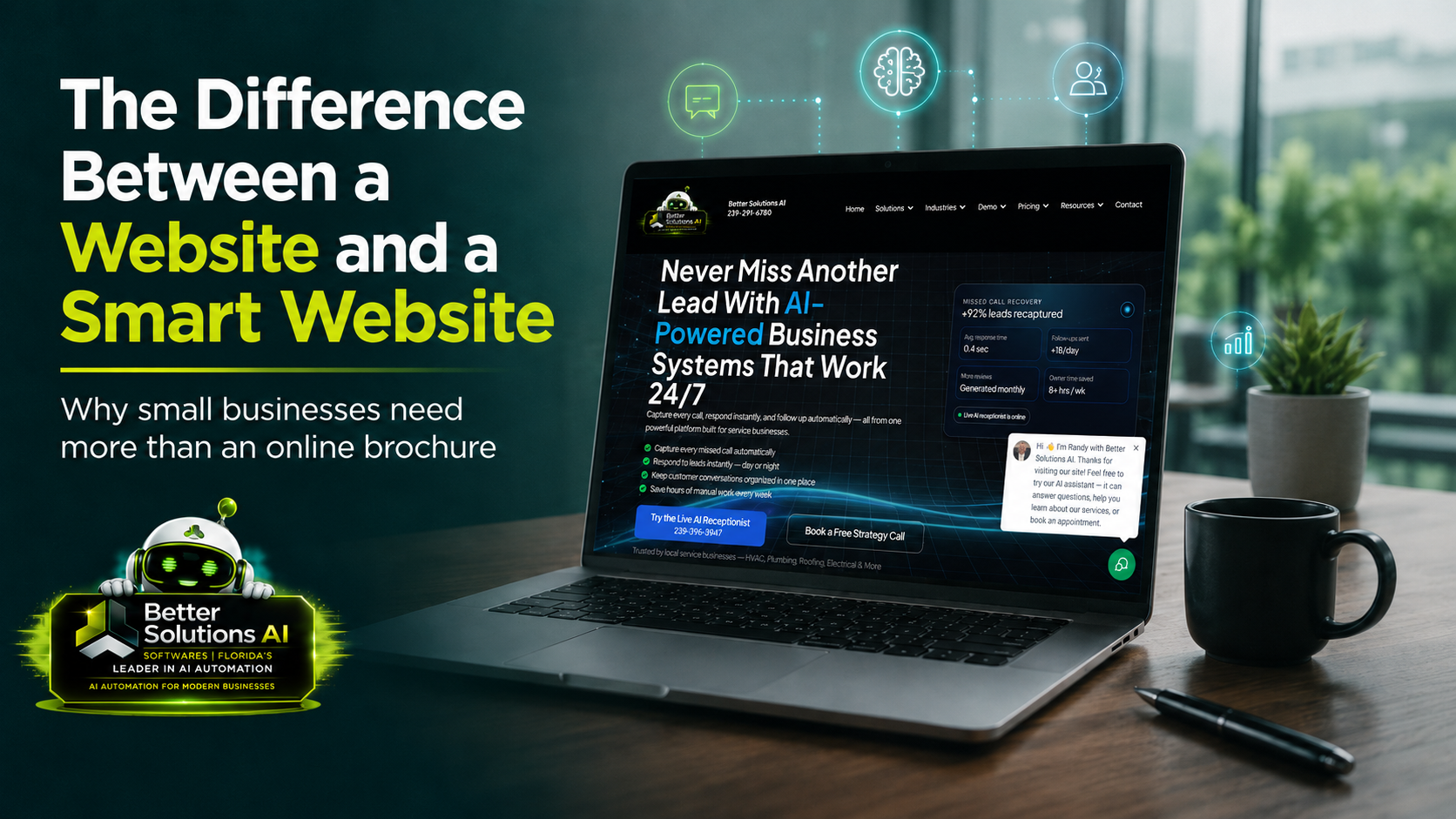
The Difference Between a Website and a Smart Website
Why small businesses need more than an online brochure
Most small businesses already have a website.
It may have the company name, phone number, list of services, a few photos, a contact form, and maybe some customer reviews. That is a good start. A website gives people a place to learn who you are and what you offer.
But here is the real question:
Is your website actually helping your business respond to new opportunities?
Because having a website and having a website that actively helps your business are two very different things.
For many small businesses, the website is still treated like a digital brochure. It sits online, looks nice, and waits for someone to take action. The visitor has to figure out what to do next. They have to call, fill out a form, leave a message, or hope someone gets back to them.
That worked better years ago.
Today, customers expect quicker answers, easier communication, and a smoother experience.
That is where the difference between a regular website and a smart website starts to matter.
A regular website gives information
A traditional website is usually built to display information.
It tells people:
who you are
what services you offer
where you are located
how to contact you
why someone may want to hire you
There is nothing wrong with that. Every business needs the basics.
The problem is that many websites stop there.
A visitor lands on the page, looks around, and then what?
Maybe they call.
Maybe they fill out the contact form.
Maybe they leave and keep searching.
Maybe they meant to come back later and never do.
Maybe they had one quick question, but they did not feel like making a phone call.
Maybe they visited after hours, when nobody was available to answer.
A regular website may look good, but it does not always help move the conversation forward.
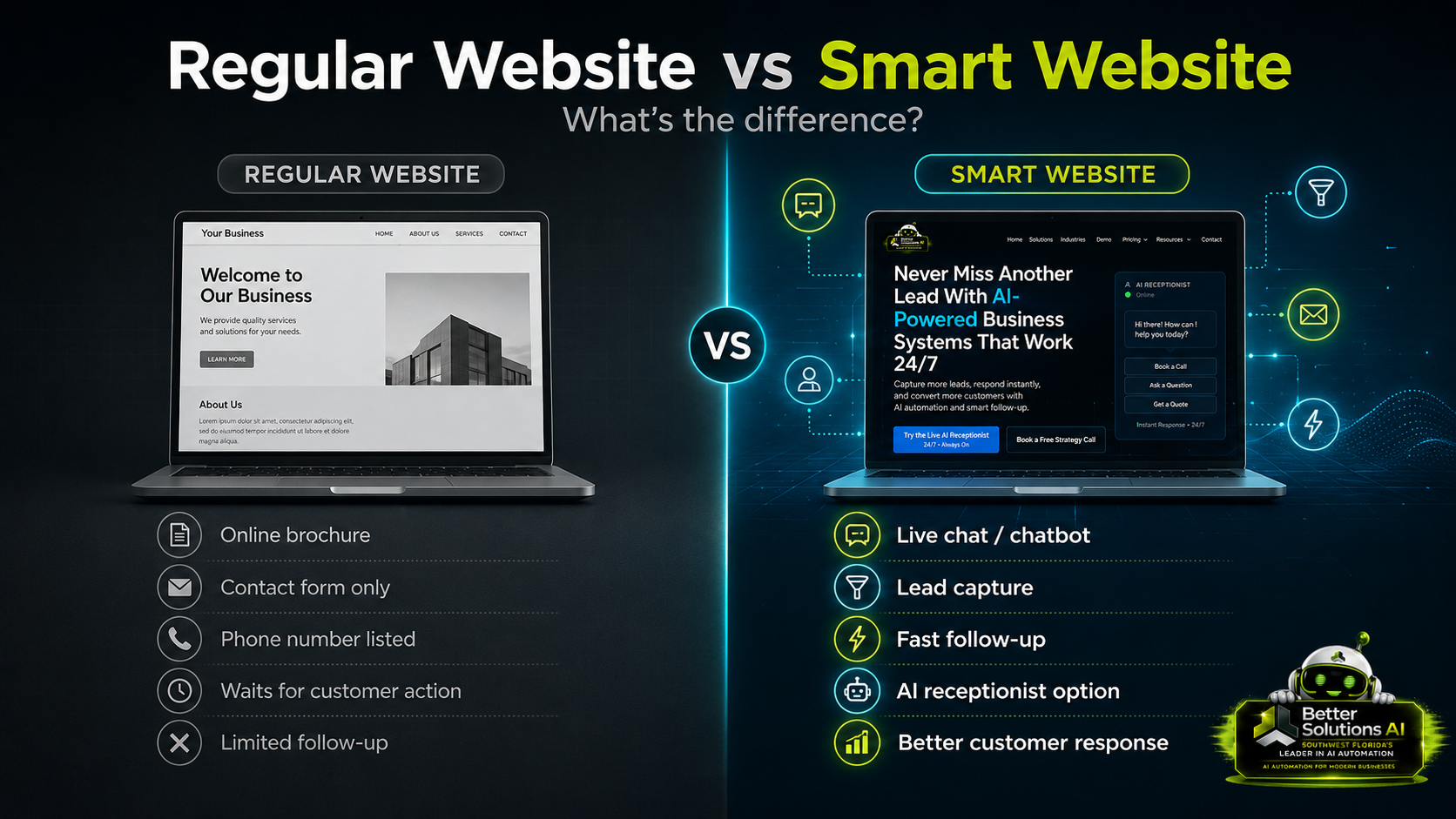
A smart website creates interaction
A smart website is built to do more than sit there.
It is designed to help visitors take the next step.
That may include:
answering common questions through a website chatbot
helping people find the right service
capturing lead information
encouraging visitors to call, message, or request help
sending inquiries into a follow-up system
supporting missed-call text-back
connecting with an AI receptionist
helping the business respond even when the owner is busy
The goal is simple:
Turn more website visitors into real conversations.
That does not mean the website has to be complicated. It does not mean replacing the business owner. It does not mean making the experience robotic.
It means giving people a better way to connect with the business when they are already interested.
Customers do not always want to wait
One of the biggest changes in customer behavior is speed.
People are used to getting answers quickly. They search online, compare businesses, read reviews, check websites, and move fast.
If they cannot find what they need, they often move on.
This is especially true for service businesses.
Someone may be dealing with a plumbing issue, an air conditioning problem, roof damage, pest concerns, a cleaning need, or a home improvement project. They are not always browsing casually. Many times, they are trying to solve a problem.
If your website gives them a way to ask a question, request help, or get guided in the right direction, you have a better chance of keeping that opportunity.
If your website only gives them a phone number and a form, you may still get the lead.
But you may also lose them to the next business that made the process easier.
A smart website supports the business behind the scenes
The real value of a smart website is not just what people see on the page.
It is what happens after they take action.
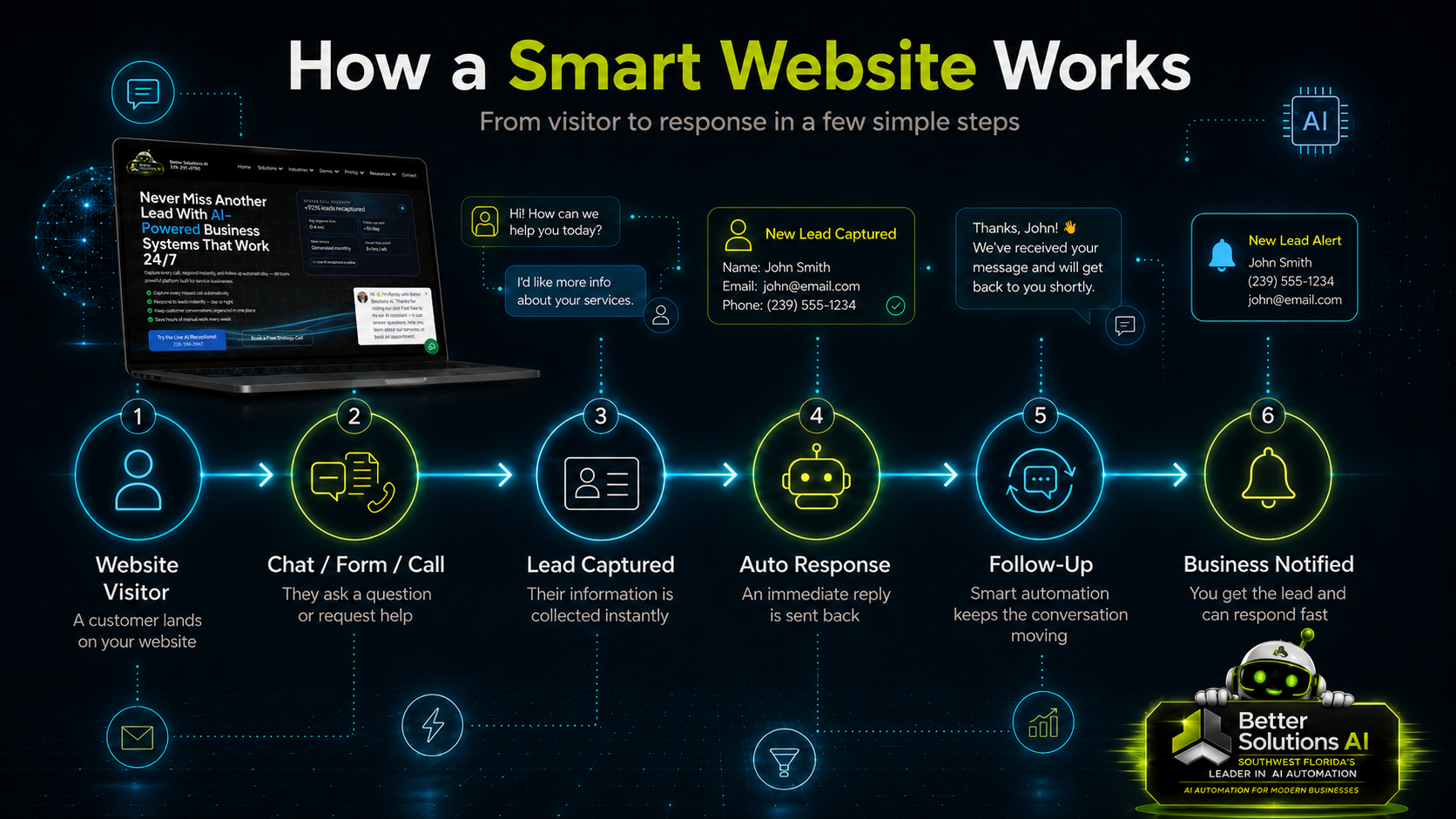
When someone submits a form, sends a message, clicks a button, or calls the business, there should be a system behind the scenes that helps manage that opportunity.
That system can help with things like:
notifying the business
organizing the lead
sending an automatic response
following up if the person does not respond
helping prevent missed opportunities
giving the business owner a cleaner way to track inquiries
This is where many small businesses struggle.
They may get leads from their website, Facebook, Google, phone calls, text messages, referrals, and emails. But without a system, things can get scattered quickly.
A smart website helps bring the pieces together.
It is not just about having a better-looking website.
It is about having a better communication process.
Smart does not mean complicated
When some people hear terms like automation, chatbot, or AI receptionist, they assume it must be complicated.
It does not have to be.
For many small businesses, smart technology can be simple and practical.
It can be as basic as:
a website that clearly guides visitors
a chatbot that answers common questions
a contact form that routes information properly
a missed-call text-back system
an AI receptionist that helps when calls cannot be answered
automated follow-up so inquiries do not get forgotten
The business owner is still in control.
The technology is there to support the business, not take it over.
That is an important difference.
A smart website is not about removing the human side of the business. It is about making sure people are not ignored, missed, or left waiting when they are trying to reach you.
A pretty website is not always enough
A website should look professional. Design matters.
But a good-looking website by itself does not guarantee results.
A beautiful website can still miss leads.
A modern design can still leave customers confused.
A contact form can still sit unanswered.
A phone number can still go to voicemail.
That is why small businesses should think beyond appearance.
The better question is not just:
Does my website look good?
The better question is:
What happens when someone is ready to take action?
Can they get help quickly?
Can they ask a question?
Can they request a callback?
Can the business follow up?
Can the system help prevent missed opportunities?
That is the difference between a basic website and a smart website.
The goal is better communication
At the end of the day, a smart website is really about communication.
It helps businesses respond better.
It helps customers get information faster.
It helps reduce missed calls, missed messages, and missed chances to earn new business.
For small businesses, that matters.
Because every inquiry has value.
Every missed call could be a job.
Every unanswered question could be a lost customer.
Every website visitor who leaves without taking action could have been an opportunity.
A smart website gives your business a better chance to connect while that person is already interested.
Final thought
A regular website gives people information.
A smart website helps create conversations.
And in today’s world, that difference matters.
Small businesses do not just need a place online where people can find them. They need a website that helps them communicate, respond, and capture opportunities more effectively.
Your website should be more than something people visit.
It should be something that helps your business respond.
About Better Solutions AI
At Better Solutions AI, we help small businesses create smarter websites and communication systems that work together.
From smart websites and website chatbots to missed-call text-back, follow-up automation, and AI receptionist options, our goal is to help businesses respond faster and stop missing opportunities.
Visit: https://bettersolutionsai.net
Call: 239-291-6780


